
Invisible characters in social media bios
Social media bios are among the most constrained text fields on modern platforms. They are short, mobile-first, and subject to aggressive truncation rules. When invisible Unicode characters are embedded in a bio, the text can look correct in the editor, then break once published. Lines refuse to wrap, truncation triggers too early, spacing feels inconsistent, and the same bio behaves differently across devices.
These failures are rarely caused by wording or length alone. They are caused by invisible structure transported through copy-paste. Non-breaking spaces, zero-width characters, and hidden formatting residue alter how platforms calculate layout and truncation. The platform follows structure, not appearance.
Bio-specific failure modes are mapped, the most common artifact families are identified, and their impact on truncation and wrapping is connected to real profile behavior across Instagram, LinkedIn, and other social platforms. For the platform hub, see Platform-specific text issues.
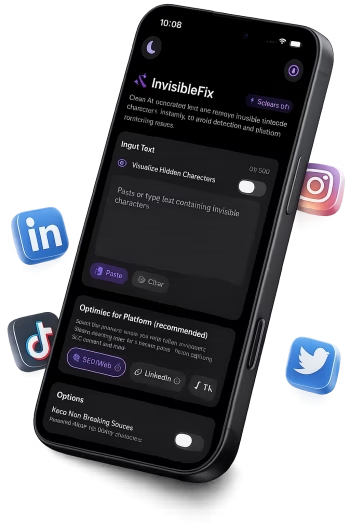
What it is
Invisible characters in social media bios are Unicode code points that alter layout and truncation while remaining hidden in the editor. They include non-breaking spaces that remove line-break opportunities, zero-width characters that split tokens invisibly, and hidden formatting residue introduced during rendering and clipboard transport. These characters are valid Unicode, which is why platforms store and interpret them even when authors cannot see them.
Because bios are rendered in narrow containers with strict limits, even a single invisible character can change behavior significantly. The visible text is not corrupted. The structure is.
Why it happens
Most bios are written outside the platform where they are published. Content is generated in AI tools, Docs, or editors, then pasted into a bio field. Each step introduces a layer where invisible structure can be preserved. Copy-paste is the main boundary where invisible artifacts cross into social platforms.
Platforms do not aggressively normalize bio input because they must support emojis, multilingual text, and consistent rendering at scale. As a result, hidden structure is preserved and interpreted during layout and truncation.
NBSP and unbreakable bio lines
Non-breaking spaces (NBSP) look like normal spaces but prevent line breaks. In a bio, a single NBSP can force a long phrase to remain unbreakable, increasing layout height and triggering truncation earlier than expected.
Zero-width characters and invisible boundaries
Zero-width characters can split tokens invisibly. In bios, this can affect how words, emojis, and symbols are grouped, indirectly influencing truncation and selection behavior.
Common symptoms
Bio issues usually appear as behavioral failures rather than visible corruption. Common symptoms include bios that truncate too early, lines that refuse to wrap naturally, spacing that changes after minor edits, and inconsistent display between editor preview and public profile view.
Why the symptom is amplified on mobile
Bios are almost always consumed on mobile. Narrow screen width and early truncation thresholds leave little tolerance for hidden structure. A character that is harmless in a long caption can break a bio immediately.
How to detect it
Invisible characters are difficult to detect visually. Editors hide them by design, and find-and-replace cannot reliably target “nothing”. Detection relies on behavioral signals.
Behavior-based signals
If a bio truncates earlier than expected after paste, behaves differently after retyping, or displays inconsistently across devices, invisible Unicode is a strong suspect.
Why manual inspection does not scale
Inspecting Unicode code points requires technical tools and desktop workflows. For social profile management, normalization is more effective than diagnosis.
How to fix it safely
Safe cleanup requires controlled normalization. Not all invisible Unicode is unwanted. ZWJ is required for emoji sequences, and some marks are legitimate in multilingual contexts. A safe workflow removes unintended artifacts that cause breakage while preserving required characters.
For bios, predictable behavior usually matters more than preserving invisible layout rules. This is why normalization is best applied after editing and before publishing. The related pages AI text issues on Instagram and Invisible characters on LinkedIn posts cover platform-specific constraints. For immediate cleanup, text can be normalized locally at app.invisiblefix.app.
Once invisible characters are removed, bios behave predictably: wrapping stabilizes, truncation triggers where expected, and profile text remains consistent across devices.
FAQ: invisible characters in social media bios
Why do social media bios truncate early?
Are invisible characters introduced by AI tools?
Why does retyping fix bio issues?
Which characters cause the most problems?
What’s the most reliable fix?
Social media bio text deep dives & platform notes
Real-world cases on bio truncation, invisible Unicode artifacts, and stable profile publishing workflows across platforms.

 Invisible Fix


Make social media bios publishing-ready
Normalize text before updating bios to keep wrapping, truncation, and mobile rendering stable across platforms.